

What Is Blockchain Technology And How Does It Work?
Let’s explore the technology behind crypto – blockchain. Blockchain utilises a peer-to-peer network concept.
Peer-to-peer P2P, allows online payments to be sent directly from one party to another, without utilising any financial institution, such as a bank.
The Bitcoin blockchain BTC is a combination of Bitcoin and blockchain. The Bitcoin white paper states a set of computational rules that determined Blockchain, a new type of distributed database, which utilises Distributed Ledger Technology (DLT).
A blockchain is essentially a database that stores information electronically, on a computer system. However, the data is stored in a different way to a traditional database. Whereas a traditional database stores data in tables, a blockchain collects the data in groups known as blocks. It creates an irreversible chain of data, when it is implemented in a decentralized system.
The first blockchain network was created in 2009 by Satoshi Nakamoto, where Bitcoin was implemented.
However, blockchain technology was initially described by researchers, Stuart Haber and W. Scott Stornetta in 1991. They described a cryptographically secured chain of ‘blocks’.
Blockchains are tamper resistant digital ledgers implemented in a distributed fashion – without a ‘central’ authority such as a bank or government.
They allow for a group of users to record transactions in a shared ledger within the community and no transaction can be edited once published. Therefore a blockchain is ‘immutable’.
With the Bitcoin blockchain, data which represents the digital currency, is attached to a digital address.
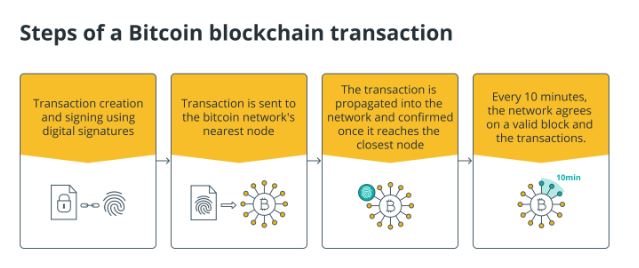
Bitcoin users can transfer rights via digital signature, to another user, and the data is recorded publicly. This process means that all of the Bitcoin users on the network can independently validate the transactions.
The Bitcoin blockchain is stored and managed in a collaborative way. Cryptographic mechanisms mean that the blockchain is more resilient to modification, tampering or forging of transactions in the ledger.
The Bitcoin blockchain refers to the data stored in ‘blocks’ which are permanent blocks of data, linked together in a ‘chain’.
The ‘block’ simply means the Bitcoin transactions stored over a period of time. Blocks are stacked on top of each other, with each transaction relying on the previous one, hence the term ‘blockchain’ was born.
When an action is recorded on the blockchain, it is time-stamped, secured and available to anybody on the network.
Cryptographic Functions And Security
Cryptography is a vital element in blockchain technology as it provides a secure communications facility and connects the blocks in a chain. It is the best method for securing data from unauthorized access, whilst utilising hash functions.
Blockchains make use of two types of cryptographic algorithms- asymmetric key algorithms and hash functions. The hash functions are used to provide the functionality of a single view of blockchain to each participant.
Hash functions are mathematical algorithms that take data input and produce a fixed length encrypted output.

This is a basic overview of blockchain technology and how it is implemented within cryptocurrency.
Subscribe to the blog for further posts on cryptography, blockchain security and more!

 totallycoined.com
Leave a comment